Overview
Chronos addresses non-Markovian long-horizon manipulation by treating observation history as the latent state of the policy dynamics. At each physical control step, Chronos forms one state-representative token from observation and proprioception, propagates the full causal history with a selective state space model, generates a multimodal coarse action prior with IMLE, and refines that prior with a second-order Schrodinger-inspired acceleration bridge.
Chronos Framework
Full-History State Encoding
One token is aligned with each physical control step. A selective state space model propagates the complete causal history as the policy state.
IMLE Action Prior
A history-conditioned IMLE generator captures multimodal coarse action chunks, keeping multiple feasible modes available for downstream refinement.
Second-Order Action Bridge
A Schrodinger-inspired acceleration field refines the coarse action prior into smoother and more physically grounded robot motion.
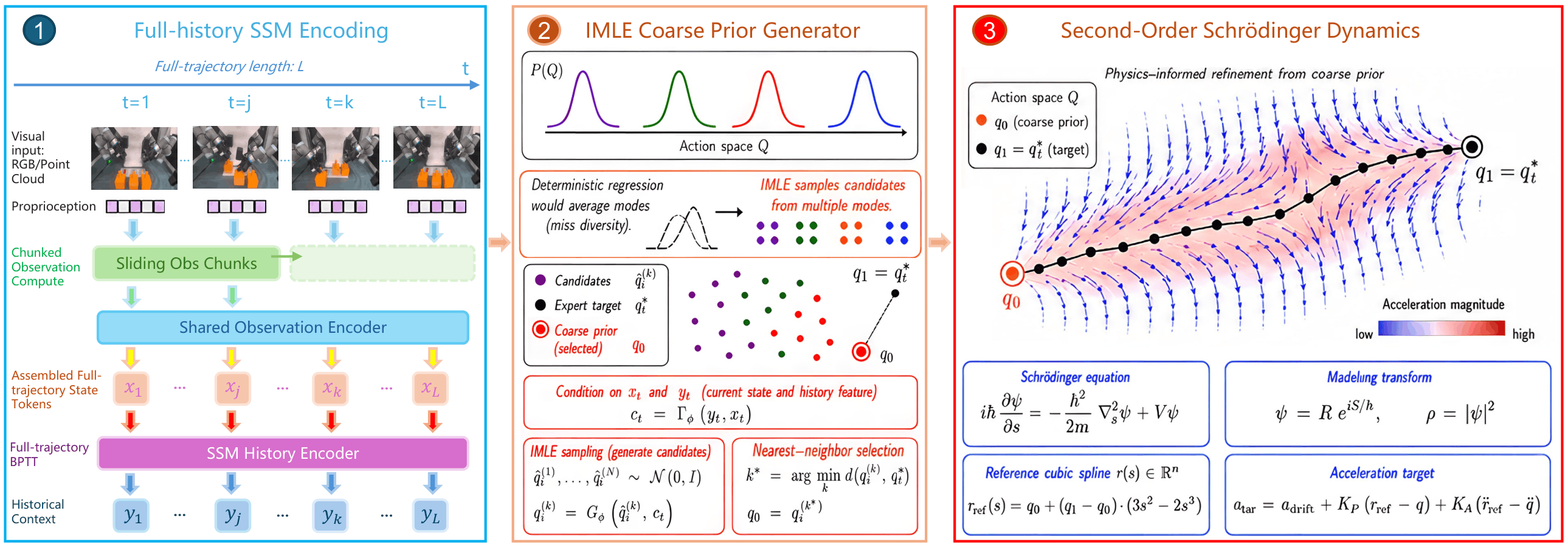
Full-history state propagation, multimodal action-prior generation, and acceleration-driven second-order refinement.
Key Results
Memory-Dependent Control
On RMBench, Chronos reaches 73.6% average success, outperforming pi0.5 by +62.4 absolute percentage points with 10× fewer parameters.
Compact Yet Strong
Chronos surpasses the memory-aware VLA Mem-0 by 22.8 points while using over 30× fewer parameters.
Real-World Validation
In real-world dual-arm experiments using a single RGB camera, Chronos achieves 78% average success and 72% on memory-dependent tasks.
Simulation and Benchmark Gallery
In ALOHA precision insertion, Chronos with the second-order action bridge yields smoother, more stable motion than the diffusion action head.
ALOHA Precision Insertion
Real-World Deployment
Real-world experiments compare pi0.5 and Chronos side by side. Chronos preserves hidden task phase and history-dependent information, while pi0.5 often skips intermediate stages or prematurely executes the final action.
Task 1: Long-Horizon Sequence
Task 2: Visible Manipulation
Task 3: Memory-Dependent Extension
BibTeX
@article{zhou2026chronos,
  title={Chronos: A Physics-Informed Full-History Framework for Non-Markovian Long-Horizon Manipulation},
  author={Zhou, Yulin and Wang, Yimeng and Wang, Nengyu and Xing, Shaojia and Tu, Shiyun and Li, Xiang and Zhang, Jingkai and Jiang, Ningbo and Lin, Yuankai and Yang, Hua and Zeng, Xiangrui and Yin, Zhouping},
  journal={arXiv preprint arXiv:2606.30318},
  year={2026}
}